 University of North Texas

 Scout Badges Private Star Party
Looking for your troop to fulfill your Girl Scouts Space Sciences Badge, or Boy Scouts Astronomy Merit Badge? We can help here at the RUAC! Join us for a special three hour Private Star Party, where we will walk through the steps of the badge as well everything that is normally included in a Private Star Party.
What's included?
- Supplies needed for completing the Badge
- Activities for the scouts to complete the Badge requirements
- Sky Tonight Tour - Constellation stories, navigating the night sky, and star-hopping
- Dobsonian Telescope Operation - instruction on how to use the telescopes and find celestial objects
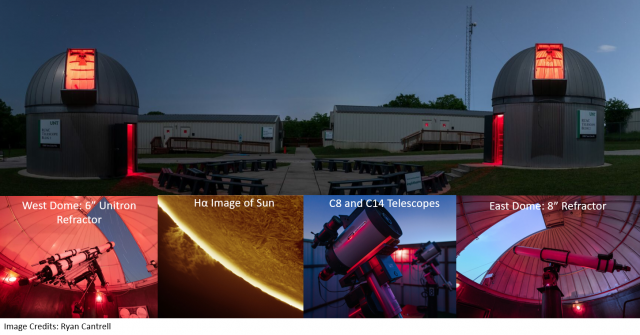
- Domed Telescope Observation - You will be given access to our 6" and 8" refractors.
- Open-Roof Telescope Observation: You will be given access to our open-roof telescope buildings which contain C14 and C8 telescopes outfitted with state of the art astrophotography and positioning equipment.
Girl Scouts Space Science Badge
Every level of the Space Science Badge, from Daisy to Ambassador, is offered with the specific requirements per level met. Multi-level troops are welcome, and we can cater to any troop combination you have.
We cover the following of each badge:
Daisy
- Explore the Sun
- Observe the Moon
- Meet the Stars
Brownie
- Meet the Neighbors
- See More Than Before
- Investigate the Moon
- Be a Stargazer
- Celebrate and Share
Junior
- Model the Solar System
- Circle the Sun
- Discover the Stars
- Use the Tools to Explore
- Share Your Sky
Cadette
- What More Can You See?
- Explore "Invisible" Light
- See the Stars in a New Way
- Expand Your Vision
- Conserve the Night Sky
Senior
- Uncover the Stuff You're Made of
- Explore the Brilliance of the Stars
- Discover Telescopes as Light Collectors
- Find the Light in the Darkness
- Share your Knowledge
Ambassador
- Discover Worlds Beyond Earth
- Dive into NASA Science
- Explore your Interests
- Dig Deeper
- Share What You've Learned
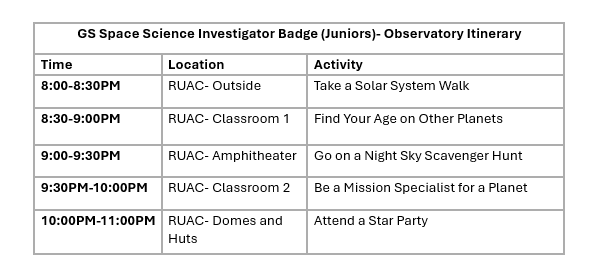
An example timeline of an event is shown below:
Boy Scouts Astronomy Merit Badge
We cover the following of the Astronomy Merit Badge below, and ask that you and your troop cover hazards, first aid, and proper clothing before arriving at your reservation.
- Explain what light pollution is and how it and air pollution affect astronomy.
- With the aid of diagrams (or real telescopes if available), do each of the
following:- Explain why binoculars and telescopes are important astronomical tools.
Demonstrate or explain how these tools are used. - Describe the similarities and differences of several types of astronomical
telescopes, including at least one that observes light beyond the visible
part of the spectrum (i.e., radio, X-ray, ultraviolet, or infrared). - Explain the purposes of at least three instruments used with astronomical
- Describe the proper care and storage of telescopes and binoculars both at
home and in the field.
- Explain why binoculars and telescopes are important astronomical tools.
- Do the following:
- Identify in the sky at least 10 constellations, at least four of which are in
the zodiac. - Identify at least eight conspicuous stars, five of which are of magnitude
1 or brighter. - Make two sketches of the Big Dipper. In one sketch, show the Big
Dipper's orientation in the early evening sky. In another sketch, show its
position several hours later. In both sketches, show the North Star and
the horizon. Record the date and time each sketch was made. - Explain what we see when we look at the Milky Way.
- Identify in the sky at least 10 constellations, at least four of which are in
- Do the following:
- list the names of the five most visible planets. Explain which ones can
appear in phases similar to lunar phases and which ones cannot, and
explain why. - Using the Internet (with your parent's permission), books, and other
resources, find out when each of the five most visible planets that you
identified in requirement 5a will be observable in the evening sky during
the next 12 months, then compile this information in the form of a chart
or table. - Describe the motion of the planets across the sky.
- Observe a planet and describe what you saw.
- list the names of the five most visible planets. Explain which ones can
- Do the following:
- Sketch the face of the moon and indicate at least five seas and five
Label these landmarks. - Sketch the phase and the daily position of the Moon at the same hour and
place, for four nights within a one week period. Include landmarks on
the horizon such as hills, trees, and buildings. Explain the changes you - List the factors that keep the Moon in orbit around Earth.
- With the aid of diagrams, explain the relative positions of the Sun, Earth,
and the Moon at the times of lunar and solar eclipses, and at the times of
new, first-quarter, full, and last-quarter phases of the Moon.
- Sketch the face of the moon and indicate at least five seas and five
- Do the following:
- Describe the composition of the Sun, its relationship to other stars, and
some effects of its radiation on Earth's weather and communications. - Define sunspots and describe some of the effects they may have on solar
- Identify at least one red star, one blue star, and one yellow star (other
than the Sun). Explain the meaning of these colors.
- Describe the composition of the Sun, its relationship to other stars, and
- With your counselor's approval and guidance, do ONE of the following:
- Plan and participate in a three-hour observation session that includes
using binoculars or a telescope. List the celestial objects you want to
observe, and find each on a star chart or in a guidebook. Prepare a log or
Discuss with your counselor what you hope to observe prior to
your observation session. Review your log or notebook with your
counselor afterward.
- Plan and participate in a three-hour observation session that includes
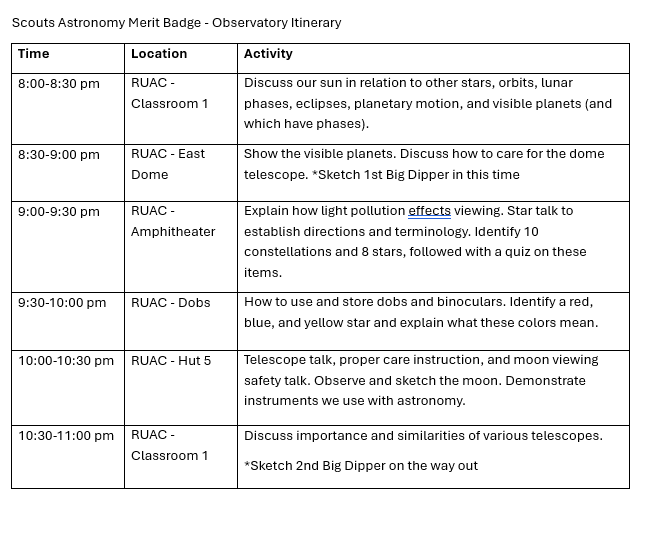
An example timeline of the event can be as follows.
How much does it cost?
Minimum fee - $400, or $20 per guest, whichever is greater
How do I make a reservation?
We require AT LEAST 2 weeks notice for all reservations.
Reservation requests can be made by sending an email to our Astronomy Coordinator
atskytheater@unt.edu.
Please include the following information in your email:
- Organization or Group name
- Contact name/email/phone/fax
- Age level/Scouting Level
- # of attendees
- Preferred date and time
- Alternate date and time
For more information please call (940) 369-8213 or email skytheater@unt.edu